An identity-forward approach to showing your work
Your link-in-bio shows your online presence, but it doesn't show who you are or what drives you.
Many creators have their work spread across different platforms. You might have your portfolio here, social media links there, and current projects somewhere else. The result is a jumble of links rather than a cohesive story. You're left with static lists, not a living picture of your work.
The identity-forward approach changes this. It builds a living profile that evolves with your work, rather than just collecting your links.
This isn't about better templates or flashier designs. It's about showing your work as an ongoing journey that grows and changes over time.
The shift:
Traditional: "Prove yourself to become"
Our approach: "Become yourself through practice"

Four Core Principles
01Making shapes who you become
Every project you take on, whether it's polished, messy, or unfinished, plays a role in your growth. Work is more than a display of skill; it's a chance to learn and develop. So don't just highlight your successes. Share your experiments and setbacks as well. Instead of only showing outputs, talk about how your projects changed your direction. What matters is the context, not just the credentials.
02You're more than a job title
You don't fit in one box. You create, teach, learn, collaborate, and build community, often all at once. These aren't separate careers; they're dimensions of one practice.
What changes: Track every dimension of your work. See how the different parts connect and strengthen each other. Find collaborators through shared patterns, not just matching labels.
03Your story is your edge
Skills become commodities. Stories stay unique. Anyone can list qualifications. Only you can connect the dots of your particular journey.
What changes: Document the moments that shaped your direction. Explain where you are now and where you're heading. Build a narrative, not just an inventory.
04Growth accelerates through connection
You develop faster with others than alone. Collaboration reveals hidden strengths. Teaching clarifies your thinking. Community reflects back parts of yourself you couldn't see solo.
What changes: Others recognize and amplify different facets of your work. You build networks of mutual growth. Connection fuels evolution.

Three Core Practices
The principles shift how you think about your work. The practices shift what you actually do.
These aren't productivity hacks or optimization frameworks. They're routines for being honest about where you are and intentional about where you're going. You don't do them once; you come back to them as your work develops.
Practice 1: Keep Your Profile Alive
Your profile isn't a monument to past achievements. It's a living document of current exploration.
Three elements create that aliveness:
Your maker statement anchors who you are right now: "I make X. Currently working on Y." Update it as you move. It doesn't need to hold everything you've ever done, just what you're bringing forward.
What's new tracks your present moment: the latest project, the new skill, the direction you're exploring. Update it when things actually shift, not on a schedule. This isn't about looking busy; it's about documenting real change.
What you stand for holds your core: three to five beliefs about your craft that don't bend with trends. They might take months to articulate clearly. That's fine. They shouldn't change every season, but they should be visible on your page.
This practice keeps your profile current without constant overhauls. You're not rebuilding; you're updating the parts that actually moved.
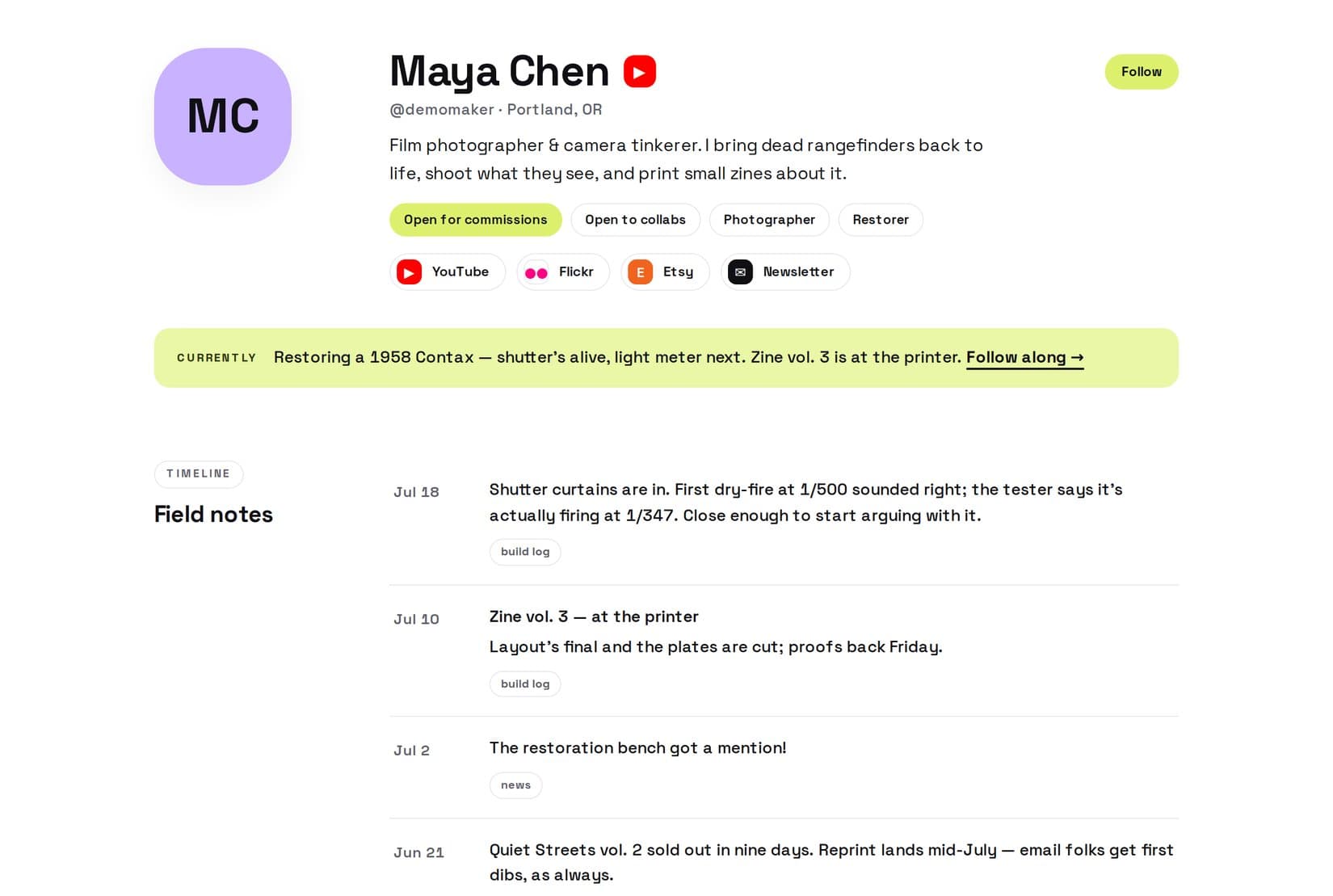
The maker statement, the Currently line and the timeline, on a real MakerID page.
Practice 2: Tell the Story Behind the Work
Projects without context are just outputs. Context turns them into evidence of becoming.
For each significant piece of work, share three dimensions:
Why: What sparked this project? Not the client brief or the assignment prompt, but the actual question or tension that made you lean in.
Challenge: What you had to navigate or learn. The skill you didn't have yet. The approach that failed first. This is where your growth becomes visible.
Impact: What changed, for you or for others. Not metrics or reach. Actual shifts. What do you understand now that you didn't before?
Practice 3: Track Your Creative Balance
You're more than a job title, so your work has many parts. Without awareness, you can pour everything into one and starve the others.
Check in at regular intervals on where your time and energy actually go:
- Making new things
- Working with others
- Teaching what you know
- Learning new skills
- Building community
- Planning ahead
This isn't about perfect balance. Some seasons need deep focus on making. Others demand collaboration. Periods of intensive learning might mean less output. That's natural.
The practice is awareness: where are you now, and where do you want to shift?
It prevents the drift that happens when you're not paying attention. Does the way you spend your time reflect your values? Or have you fallen into patterns pushed by outside pressure instead of your own goals?
Start Anywhere
These practices work whether you're on your first project or running an established practice. They adapt to where you are.
Pick what feels most useful right now. If you're just beginning, Practice 2 might matter most: learning to document your thinking alongside your making. If you're established but scattered, Practice 1 creates needed coherence. If you're productive but feel unbalanced, Practice 3 offers a checkpoint.
The method isn't about doing everything at once. It's a gradual shift from a static presentation to a living practice.
MakerID is flexible. You don't need the whole framework to get value from it. If you need a link-in-bio page, build one. If you want to keep a running log of your progress, your timeline does that too. The platform works either way. What sets you apart is your progress, not the tool. Start wherever you want and take it from there.
Your page is the first practice.
Claim your username, write your maker statement, and let the page grow from there.